

AMD Introduces the Instinct MI430X AI Chip With HBM4 Memory and Next-Gen CDNA Architecture for Superior AI Performance
AMD has taken a significant step forward with the unveiling of the Instinct MI430X, a powerhouse designed for next-generation HPC systems. This latest addition to AMD’s lineup showcases impressive advancements and sets a new benchmark for performance.
Revolutionary Features of AMD’s Instinct MI430X
Since the debut of the Instinct MI300 series, AMD has been on a mission to enhance its AI hardware offerings. The Instinct MI430X, part of this evolution, is engineered for expansive AI environments and features cutting-edge components and architectural improvements. While AMD has kept some details under wraps, reports suggest that the MI430X is crafted for hardware-focused workloads, thanks to its remarkable specs.
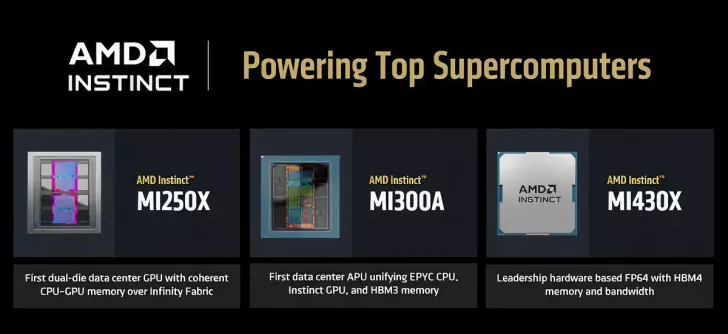
The MI430X boasts the next-generation CDNA architecture, likely CDNA 5, and includes a staggering 432GB of HBM4 memory with a bandwidth of 19.6TB/s. This chip serves as a ‘true successor’ to the Instinct MI300A, which was widely embraced by the El Capitan HPC system. The enhancements present in the MI430X clearly demonstrate AMD’s substantial leap in computing power.
Empowering Future HPC Systems
Aiming to deliver exceptional double-precision HPC and AI capabilities, the MI430X is set to make waves in various high-performance computing environments. Here are two notable implementations:
- Discovery, at Oak Ridge National Laboratory, stands as one of the United States’ pioneering AI Factory supercomputers. By incorporating AMD Instinct MI430X GPUs along with next-gen AMD EPYC “Venice” CPUs on the HPE Cray GX5000 platform, Discovery will empower U.S. researchers to train, fine-tune, and deploy vast AI models, advancing scientific fields like energy research, materials science, and generative AI.
- Alice Recoque is a newly announced Exascale-class system in Europe. It integrates AMD Instinct MI430X GPUs and next-gen AMD EPYC “Venice” CPUs on Eviden’s BullSequana XH3500 platform, offering exceptional performance for HPC and AI tasks. The system leverages the massive bandwidth and energy efficiency of the MI430X to propel scientific breakthroughs while adhering to strict energy efficiency standards.
AMD’s advancements, particularly with the Instinct MI455X AI chip, are expected to challenge NVIDIA’s dominance in the AI market, suggesting a thrilling competitive race in the near future.