

ASRock Unveils H610 Motherboard Featuring Dual DDR4 & DDR5 Support
If you’re finding it difficult to acquire costly DDR5 memory, there’s an innovative answer on the horizon. ASRock has introduced an accessible motherboard for those using older Intel processors, providing a bridge for both DDR4 and DDR5 memory options.
ASRock’s New H610M Combo Unveiled
ASRock quietly rolled out the H610M Combo, a pioneering motherboard featuring both DDR4 and DDR5 DIMM slots. This dual compatibility strategy addresses current memory dilemmas, granting users the flexibility to choose their preferred memory type. It marks a significant first step in mainstream motherboard offerings from a major manufacturer.
The H610M Combo is designed as an entry-level micro-ATX motherboard equipped with the LGA1700 socket. While it’s not aimed at high-end users, it stands as a solid option for building budget-friendly PCs with support for Intel’s 12th, 13th, and 14th generation CPUs. This micro-ATX board houses an impressive total of six DIMM slots, split between four DDR5 and two DDR4 slots, allowing for versatile memory configurations.
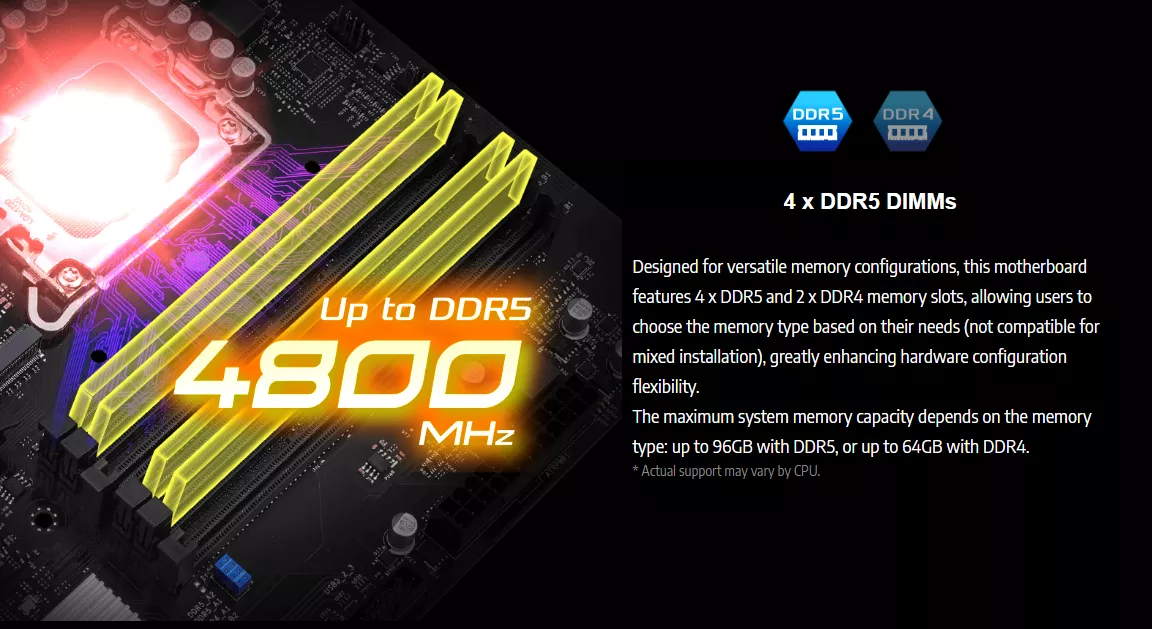
These DIMM slots, however, cannot be used simultaneously; you must choose between DDR4 or DDR5. The motherboard can support dual-channel configurations with up to 96 GB of DDR5 at speeds of 4800 MT/s. As for DDR4, it accommodates up to 64 GB, reaching speeds of 3800 MT/s, dependent on your memory setup.
Expansion and Connectivity Features
The board includes three PCIe x16 slots: one Gen 4.0 and two Gen 3.0 ports. The primary slot operates at x16 mode, while the chipset-managed secondary slots function in x1 mode. Additionally, there’s a legacy PCIe slot. For storage, users have access to one M.2 port with Gen 3.0 speeds and four SATA ports.
When it comes to connectivity, the I/O section offers a nostalgic throwback to the early 2010s, featuring a selection of USB ports, a Type C port, a PS/2 port, and a 2.5G LAN. Video connections include VGA, DVI, and HDMI outputs, complemented by a set of audio jacks.
This motherboard’s design represents a strategic approach to tackle the memory transition period, offering flexibility and cost-effectiveness for PC builders.