

Core Ultra 7 270K Plus Boosts Multi-Core Performance by 9.5% in PassMark, Rivals 285K
As the anticipation for CES 2026 builds, exciting details emerge about Intel’s Arrow Lake Refresh CPUs. With benchmark results surfacing, enthusiasts are getting a glimpse of what these high-end processors have to offer. One standout is the Core Ultra 7 270K Plus, which is already making waves in performance tests.
Core Ultra 7 270K Plus Takes on the Competition
The Core Ultra 7 270K Plus is expected to bring significant improvements in multi-threaded performance, a trend that continues as users transition from the Core Ultra 7 265K. Recent benchmarks on PassMark reveal the 270K Plus going toe-to-toe with its larger counterpart, the Core Ultra 9 285K. Compared to Geekbench, PassMark provides a clearer picture of the chip’s true capabilities, and the results speak for themselves.
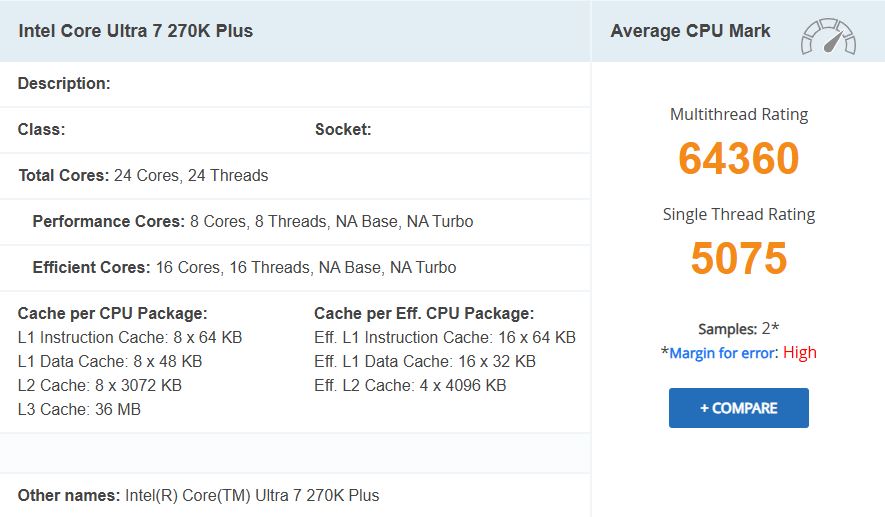
In a significant upgrade, the Core Ultra 7 270K Plus boasts four additional E-cores, allowing it to compete closely with the Core Ultra 9 285K. This new model is approximately 3% faster in single-core performance compared to the Core Ultra 7 265K and delivers nearly 9.5% higher multi-core results. Scoring over 5,000 points in single-core tests and achieving a multi-core score of 64,361, it shows remarkable improvement, aligning more closely with the 285K.
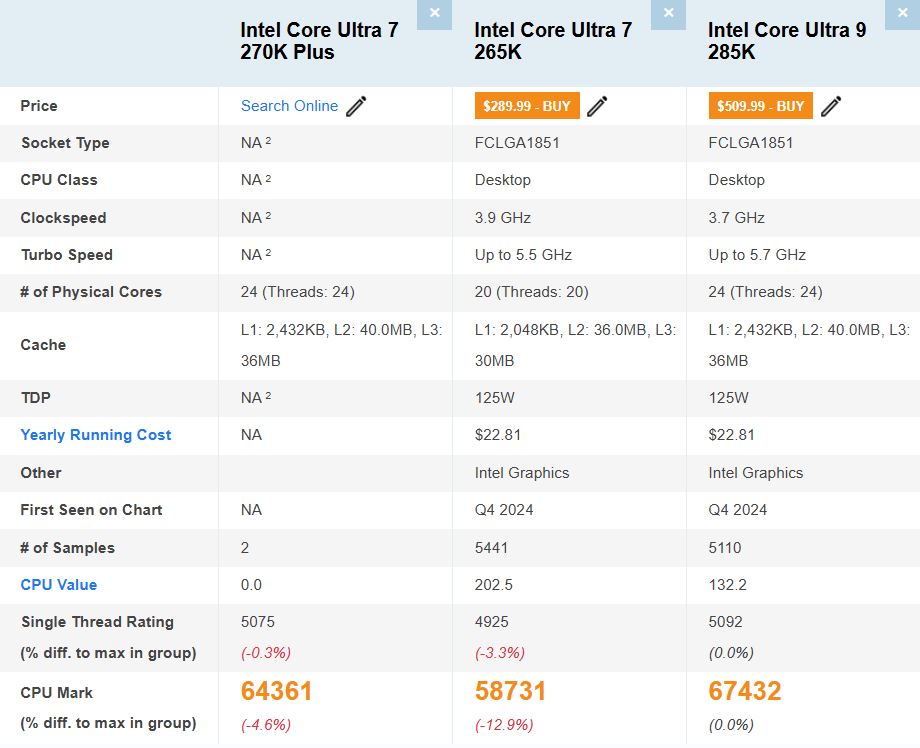
Despite being slightly slower than the 285K, the 270K Plus shares its robust 24-core configuration, featuring an 8 P + 16 E core design. Its clock speeds are nearly identical, with a notable exception in the max E-core boost clock. Additionally, the 270K Plus offers a larger cache than the 265K, leveling it with the Ultra 9 285K.


While only two samples have been tested on PassMark so far, the results will gain accuracy as more units are evaluated. The Arrow Lake Refresh lineup is expected to include the Core Ultra 5 250K Plus, Core Ultra 7 270K Plus, and Core Ultra 9 290K Plus. These models will likely feature higher clock speeds or more cores, but many elements will remain consistent with their predecessors.
Intel Core Ultra 200S “Arrow Lake” and Arrow Lake Refresh CPU Specs
| CPU | Cores/Threads | Base Clock (P/E Core) | Max Boost (P/E Core) | Cache (L3 / L2) | Memory Support | TDP (PL1 / PL2) | Price (SEP) |
|---|---|---|---|---|---|---|---|
| Core Ultra 9 290K Plus | 24/24 (8+16) | 3.7 / 3.2 GHz | 5.6 / 4.8 GHz | 36 MB / 40 MB | DDR5-7200 | 125W / 250W | TBD |
| Core Ultra 9 285K | 24/24 (8+16) | 3.7 / 3.2 GHz | 5.5 / 4.6 GHz | 36 MB / 40 MB | DDR5-6400 | 125W / 250W | $589 US |
| Core Ultra 7 270K Plus | 24/24 (8+16) | 3.7 / 3.2 GHz | 5.5 / 4.7 GHz | 36 MB / 40 MB | DDR5-7200 | 125W / 250W | TBD |
| Core Ultra 7 265K | 20/20 (8+12) | 3.9 / 3.3 GHz | 5.4 / 4.6 GHz | 30 MB / 36 MB | DDR5-6400 | 125W / 250W | $394 US |
| Core Ultra 7 265KF | 20/20 (8+12) | 3.9 / 3.3 GHz | 5.4 / 4.6 GHz | 30 MB / 36 MB | DDR5-6400 | 125W / 250W | $379 US |
| Core Ultra 5 250K Plus | 18/18 (6+12) | 4.2 / 3.5 GHz | 5.3 / 4.7 GHz | 24 MB / 26 MB ? | DDR5-7200 | 125W / 159W | TBD |
| Core Ultra 5 245K | 14/14 (6+8) | 4.2 / 3.6 GHz | 5.2 / 4.6 GHz | 24 MB / 26 MB | DDR5-6400 | 125W / 159W | $309 US |
| Core Ultra 5 245KF | 14/14 (6+8) | 4.2 / 3.6 GHz | 5.2 / 4.6 GHz | 24 MB / 26 MB | DDR5-6400 | 125W / 159W | $294 US |