

AMD has officially unveiled the highly anticipated FSR Redstone update, marking a significant leap in gaming technology. This update introduces a suite of enhancements: FSR Upscaling, FSR Frame Gen, FSR Ray Regeneration, and FSR Radiance Caching. Gamers worldwide will soon experience these advancements as they become integrated into upcoming titles.
FSR Redstone: A New Era of Gaming Enhancement
The FSR Redstone update is packed with innovations, including upgraded versions of prior technologies. Among these, Ray Regeneration stands out as a machine learning-powered tool designed to enhance ray-traced visuals in games, initially introduced in Call of Duty: Black Ops 7. This feature exemplifies AMD’s collaboration with Microsoft to rival NVIDIA’s DLSS Ray Reconstruction.
The Potential of FSR Radiance Caching
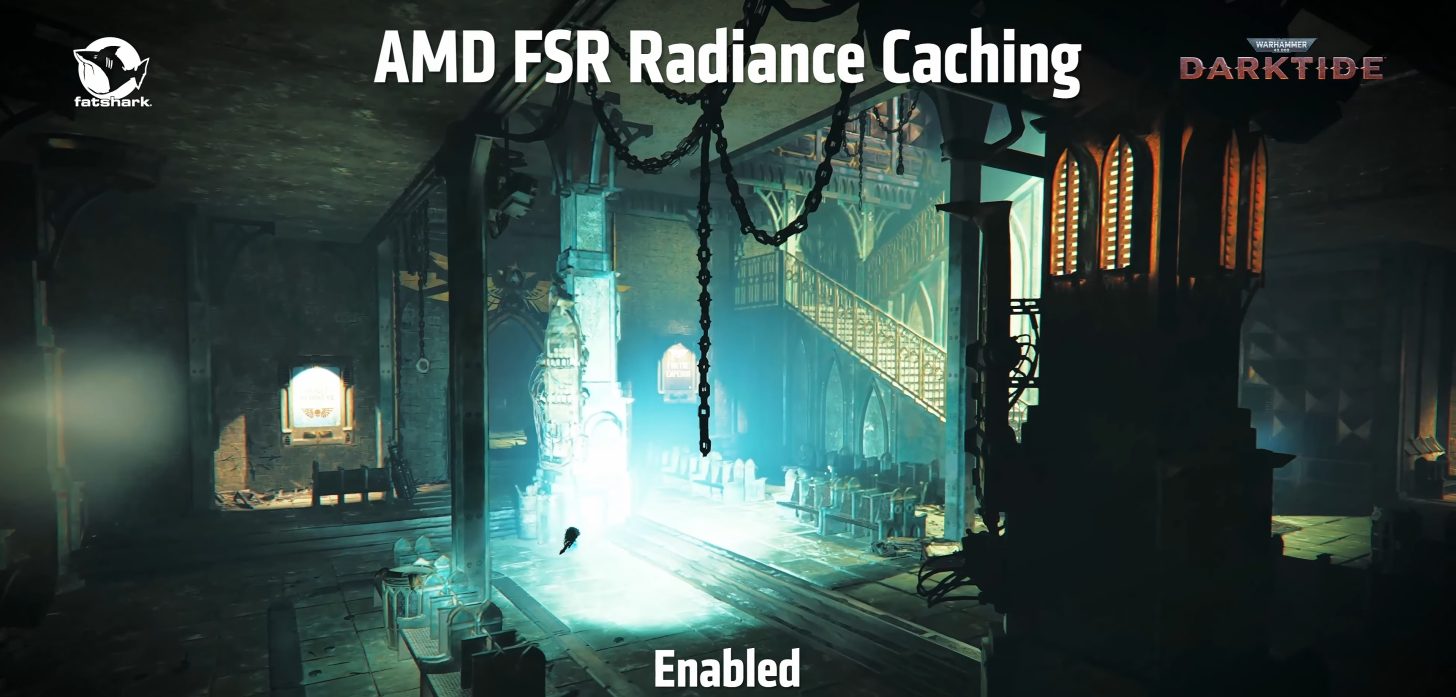
FSR Radiance Caching, unveiled in a tech demo for Warhammer 40K Darktide, promises to revolutionize gaming visuals. Although not yet featured in any live game builds, this cutting-edge technology utilizes a machine learning model to improve global illumination in real-time, offering dynamic lighting environments without pre-computation.
Fatshark, the developer behind Darktide, sees immense potential in this technology. While the feature remains experimental, their CTO, Mikael Hansson, expressed excitement about the collaboration with AMD, emphasizing the future of gaming and technology advancement.

In Comparison: AMD’s Radiance Caching vs. NVIDIA’s Neural Radiance Cache
FSR Radiance Caching bears similarities to NVIDIA’s RTX Neural Radiance Cache, introduced at CES 2025. Both technologies aim to accelerate path tracing through machine learning, with NVIDIA’s technique currently available in Portal with RTX. These advancements reflect a growing trend towards leveraging AI to enhance gaming experiences.
AMD’s FSR Redstone update, with its innovative suite of features, sets a new benchmark in gaming technology.