
If you played Zero Dawn and thought Guerrilla couldn’t possibly stack more systems, icons, and robo-dinosaurs on top of that foundation, surprise: they absolutely did. This Horizon Forbidden West review is about a sequel that constantly threatens to drown you in options, but keeps you hooked with a cast you actually want to help and a world that feels on the brink of collapse in all the right ways.
From the first minutes, you’re dropped back into the boots of Aloy Horizon Forbidden West, a hero who has gone from outcast to reluctant savior and now has a planet-sized to-do list. The stakes are higher, the map is bigger, and the robots are angrier. The question is whether all that escalation turns Forbidden West into an essential follow-up or just noise.
A World Saved Once, Breaking Again
Forbidden West doesn’t waste much time recapping. The game assumes you remember who Sylens is, why GAIA matters, and what happened to Hades. That can make the early hours dense, but it also gives the Horizon Forbidden West story a sense of momentum: Aloy isn’t starting from scratch, she’s racing against a failing biosphere.
The premise is simple but effective. Defeating Hades in the last game didn’t fix the planet; it just stopped an immediate apocalypse. Now, the biosphere itself is unraveling, corruption is poisoning crops, and climate systems are glitching out. Aloy heads west, chasing fragments of lost tech that might reboot the world before it truly dies.
What sells it isn’t the sci-fi jargon, but the people tied to every crisis. Tribal leaders clinging to power, smug salvagers with big Vegas dreams, young soldiers trying to define themselves outside of war – the Horizon Forbidden West story constantly pulls you into smaller, more grounded conflicts. Even when the plot spirals into space-age mega-AI drama, it keeps circling back to how those decisions land on regular folks scraping by in the ruins.
Systems on Systems – Combat, Skills, and Robo-Dinosaurs
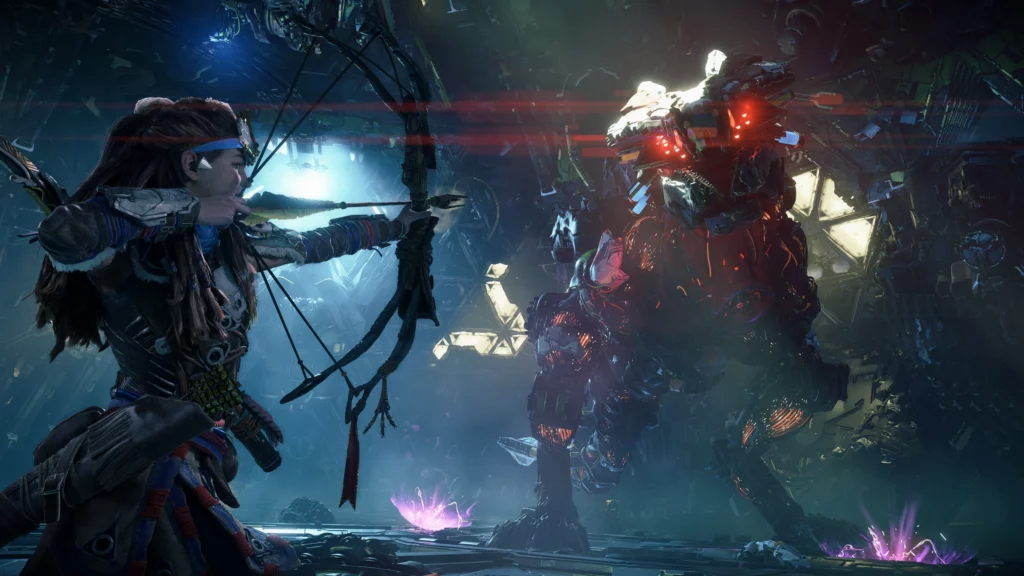
Moment to moment, Horizon Forbidden West gameplay is still all about planning, scanning, and dismantling. Those towering Horizon Forbidden West machines aren’t just health bars; they’re moving piles of breakable parts, status weaknesses, and glowing opportunities. Strip off a cannon to turn it against its owner, blow up a coolant canister to freeze a pack, or ignite a fuel sac and watch a chain reaction clear half the arena.
The sequel doubles down on variety. Aloy now juggles more weapon types than ever, each with its own trick shots and elemental flavors. Bows, slings, spike throwers, shredders, blast slings, tripcasters – it’s a toolbox that can feel almost too big. When the Horizon Forbidden West combat clicks though, it’s ridiculously satisfying: laying down tripwires, tagging a machine with acid, swapping to shock arrows to stun, then finishing with a precisely placed tear blast feels like orchestrating a robotic car crash.
All of this ties into a dramatically expanded Horizon Forbidden West skill tree. Instead of a handful of linear tracks, you now get six hefty trees that specialize in stealth, traps, melee, machine overrides, ranged attacks, and survivability. Valor Surges act as ultimate abilities tied to these trees – one might give you a brief stealth cloak, another turns you into a walking crit machine for a few glorious seconds.
The downside is decision fatigue. You unlock points constantly, but not every skill feels meaningful. Some perks are game-changers, others feel like the upgraded version of fine print. If you’re not careful, you end up hoarding points simply because you’re tired of analyzing minor percentage bumps.
An Open World That Actually Feels Lived In
On the surface, Horizon Forbidden West open world design checks every AAA box: tall towers to climb, map icons sprinkling every horizon, collectibles hiding in every valley. What keeps it from feeling like a pure checklist is how often those icons lead to actual stories instead of generic fetch quests.
The Horizon Forbidden West side quests are where the game quietly flexes. A simple request to find missing soldiers turns into a multi-stage investigation of a splintered tribe. Helping a village defend their fields reveals a political coup simmering under the surface. A salvage contract chain evolves from “go grab some parts” into a surprisingly heartfelt ode to showmanship and storytelling in a post-apocalyptic Vegas.
You’ll still do plenty of familiar tasks – clear enemy camps, hunt specific machine parts, tackle climbing puzzles in relic ruins – but they’re framed in ways that feel tailored instead of automatically generated. It’s not completely free of busywork, but Forbidden West almost always tries to justify why you’re doing something beyond “more XP.”
Eyes and Ears – One of the Best-Looking Games on PS5
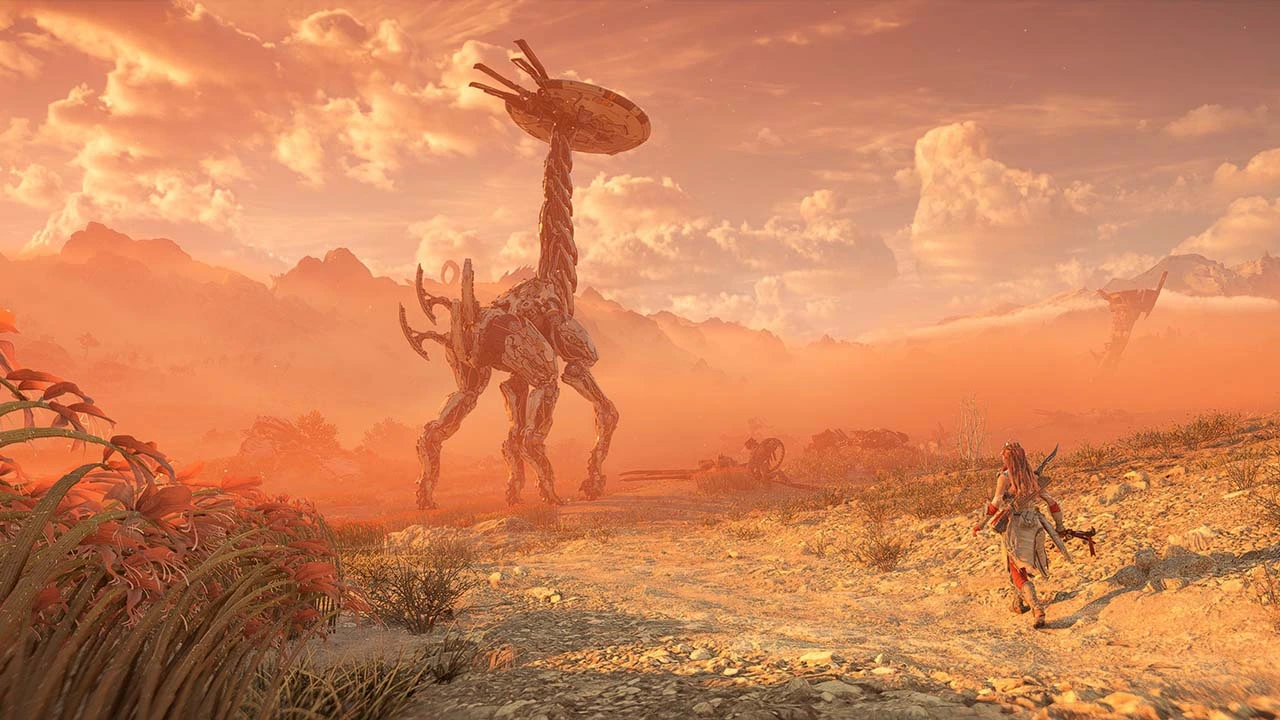
Let’s not dance around it: Horizon Forbidden West graphics are ridiculous. On PlayStation 5, this Horizon Forbidden West PS5 review has to mention how often the game just stops you in your tracks. Sunlight cutting through redwood forests, sandstorms chewing across deserts, storms rolling in over drowned cities – Forbidden West’s art direction and tech are constantly working together to sell the idea of nature reclaiming a dead world.
Character models are equally impressive. The metals, fabrics, and bone ornaments in every armor set look hand-assembled, and facial animation in the main cast frequently reaches “TV show close-up” quality. The flip side is that less important NPCs can look stiff or oddly animated by comparison, but when the game cares about a moment, you can tell.
All of that makes Forbidden West an easy pick when people talk about the best PS5 games. Even in performance mode, which sacrifices some pixel density for 60 fps, the game looks sharp and fluid. Combine that with strong 3D audio and chunky machine roars, and the presentation ends up doing a lot of heavy lifting for immersion.
Complete Edition, Burning Shores, and the Road to PC
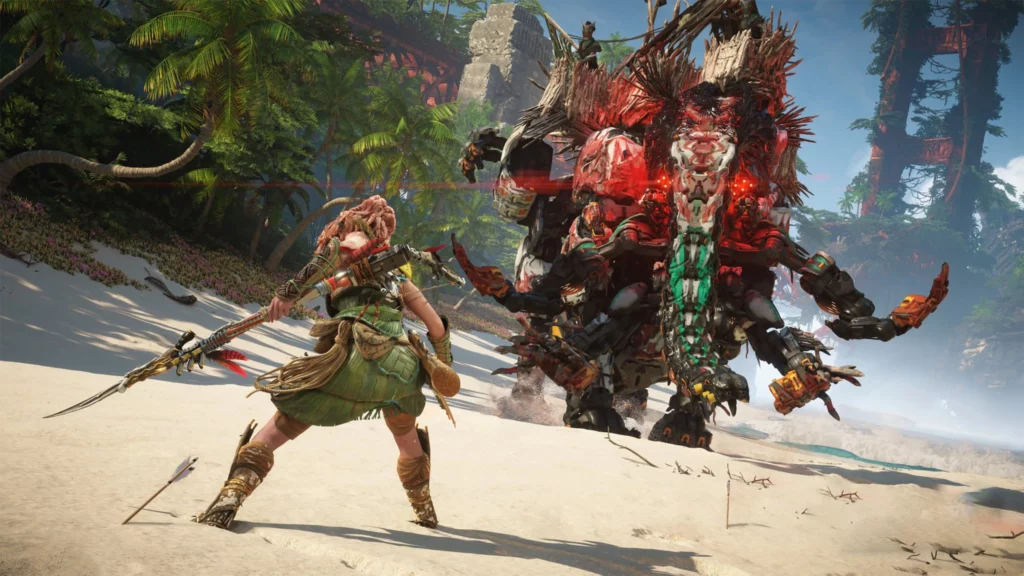
If you’re jumping in now via Horizon Forbidden West Complete Edition, you’re getting a pretty generous package. It wraps the base game with the later Horizon Forbidden West Burning Shores DLC, which continues Aloy’s journey in a visually striking, lava-scarred version of Los Angeles. Burning Shores pushes both the story and the tech, with bigger aerial combat setpieces and some of the wildest machine designs in the series so far.
Then there’s the future of the Horizon Forbidden West PC port. Bringing the game to a wider audience means new players will experience this massive adventure with higher frame rates, ultrawide support, and all the usual PC bells and whistles. If the port follows the path of other Sony titles on PC, Forbidden West could become the definitive benchmark for “can my rig handle this?”
For newcomers, that combination – Complete Edition plus PC release – makes this a great time to dive in. Veterans, meanwhile, get a reason to revisit old saves, tweak builds, and see how different choices play out with all content under one umbrella.
The Good, The Bad, and The Overwhelming
Before we get to the final verdict, it’s worth stepping back and looking at what sticks after dozens of hours. There’s the thrill of barely surviving a fight with a colossal apex machine. There’s the quieter satisfaction of solving an environmental puzzle in a relic ruin. And there’s the fatigue of staring at a map full of icons you’ll never realistically clear.
To put it simply, Forbidden West is a game defined by excess. That excess can be exhilarating, but it can also smother you in options and gear variants you’ll never use.
Here’s how it shakes out in broad strokes.
On the plus side, the combat sandbox is flexible and expressive. The writing around core characters is strong, and the worldbuilding is consistently interesting. The art direction and technical performance often feel generational.
On the negative side, the sheer volume of systems means not everything gets the attention it deserves. Inventory and build management can be fiddly and confusing. Some skills and weapon types feel redundant, and the user interface sometimes struggles to keep up with how much stuff you’re carrying, upgrading, and comparing.
Verdict – A Frontier Worth Getting Lost In
Horizon Forbidden West is one of those sequels that takes “more of everything” almost too literally, but somehow gets away with it. The combat evolves just enough to stay fresh, the story digs deeper into the world without losing the human angle, and the Horizon Forbidden West open world manages to feel like a place full of people rather than a giant board full of pins.
If you bounced off Zero Dawn because you didn’t like hunting machines or juggling elemental weaknesses, this probably won’t change your mind. But if you clicked with that loop, Forbidden West is more confident, more ambitious, and more willing to slow down and let you actually talk to the people you’re saving.